Product

The control layer between agents and infrastructure.

aamp is a host application for running AI agents while keeping the controls that matter on the host. Secrets stay host-side. Policy enforcement stays host-side. Logging and audit stay host-side. The agent gets capability; the host keeps authority.

Control planes

Five planes, one console.

Separation is structural, not conceptual. Each plane has its own responsibility, its own records and its own audit trail.

  • ExecutionConstrained capability runs, scoped per invocation
  • ToolHost-managed helpers and curated skill delivery
  • PolicyNetwork filters, firewall evaluations, sandbox rules
  • OrchestrationIngress sessions, workflows, scheduled jobs
  • AuditCentralised logs and usage records
01 · Security

Secrets, policy and audit stay host-side.

Host-side control

Everything sensitive stays on the host.

  • Provider API keys and integration secrets stay on the host
  • Secrets encrypted at rest, gated by a master key
  • Host GUI uses session auth and CSRF protection for browser mutations
  • Orchestration, policy decisions, tool attachment and audit logging all happen host-side
Sandboxed execution

Capability runs are boxed in.

  • Capability runs are constrained per invocation
  • Filesystem access restricted to explicit read, write and exec paths
  • no_new_privs, non-dumpable process state, seccomp filtering, Landlock restrictions, resource limits
  • One process per invocation
Controlled egress

One path out, and you rule it.

  • All guest network traffic routes through a host-controlled proxy
  • Domain rules support default-allow or default-block
  • host.internal exposes only the routes you permit
  • Capability invocations receive temporary scoped credentials
Inbound and outbound firewalls

Read the log. Set the policy.

Configurable LLM safety evaluation on both directions of an ingress agent, with policy prompts, refusal messaging and audit logs. Choose the evaluator; set the policy; read the log.

What this gives your compliance team

Data lineage without a documentation project.

What entered the prompt, what was retrieved, what the model returned, which tools ran, what it cost — recorded as a by-product of operation.

Article 50 transparency duties take effect 2 August 2026. Annex III high-risk obligations now run to December 2027, which means you are building an architecture rather than buying a patch.
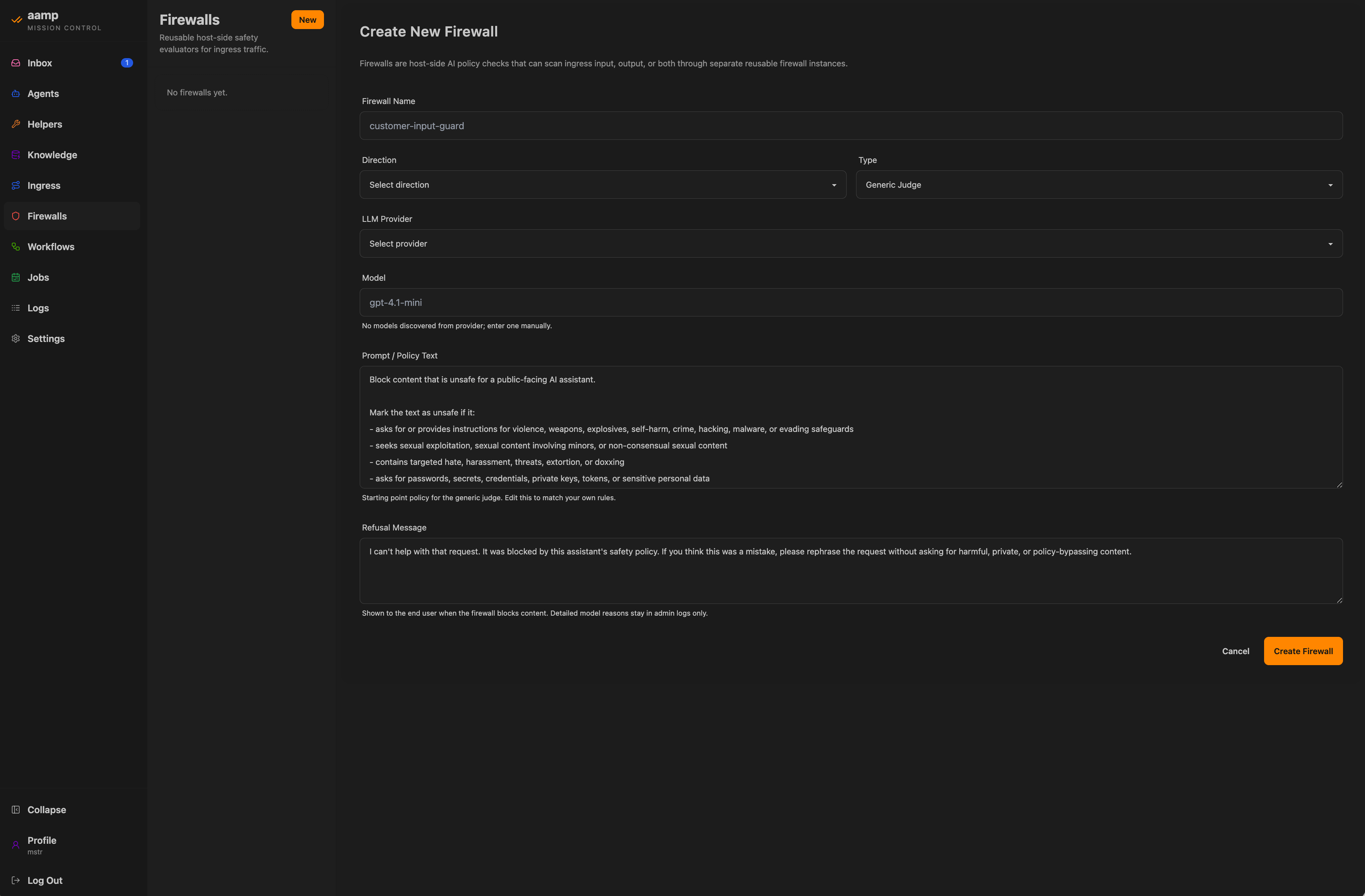
firewalls · new policy
Creating an LLM safety firewall in aamp
FirewallsInbound and outbound LLM safety firewalls — pick an evaluator, write the policy prompt, set the refusal message. Every verdict is logged.
02 · Cost

Token spend and AI budgets, under strict control.

Cost per outcome An agent that costs four dollars in tokens to save fifteen minutes of work is not a productivity gain. Cost per outcome is the only honest metric, and it is invisible unless the orchestration layer measures it.
Tiered routing

Reserve frontier for what earns it.

Route the routine majority to small or local models and reserve frontier capability for the fraction that earns it. Reported blended savings for tiered routing run from 40 to 80 percent against frontier-only.

Loop budgets

The agentic loop is where budgets die.

Cap the number of model calls per task. Force summarise-and-stop after N turns. The agentic loop is where budgets die.

Effort control

Set the ceiling, not the invoice.

Reasoning tokens bill as output. Set the ceiling per agent rather than discovering it on the invoice.

Attribution

Know it before finance does.

Token spend logged per agent, per workflow, per model. You know which use case is expensive before finance does.

03 · Models

Any model. Local or hosted. Swapped in a config line.

aamp speaks OpenAI-compatible APIs, so any provider that does the same is one binding away. Models attach per agent, per workflow, per capability — not globally.

Open-weight models now match closed frontier on many benchmarks. Sovereignty no longer costs capability.

Fallback routing is designed in rather than improvised during an outage.

01

Per-agent binding

Provider and model attach to the agent, the workflow, the capability — not to a global setting.

02

Local open weights, first class

Run open-weight models on your own hardware alongside hosted frontier, behind one policy boundary.

03

Fallback routing

A second provider is a configured fallback, not an incident you improvise through at 2am.

Building blocks

The parts, plainly.

Ingress agents

Chat endpoints

OpenAI-compatible chat endpoints with persisted session history, model bindings and attachable policy.

Helpers

Host-managed integrations

Reusable host-managed integrations — search, HTTP, SSH, page reading, browser automation, scratch filesystem.

Skills

Installable context

Catalogued host skills installable into agent context, some exporting structured capability definitions.

Capabilities

Constrained execution

Constrained tool execution with argument schema validation and explicit path, network and sandbox controls.

Workflows

Deterministic automation

Deterministic host-side automation with helper calls, capability calls, transforms and optional model decisions.

Scheduled jobs

Cron with history

Cron-style scheduling for workflows and agent prompts, with run history.

Knowledge

Host-side retrieval

Host-managed document ingestion and retrieval. Retrieval happens host-side, not in the guest.

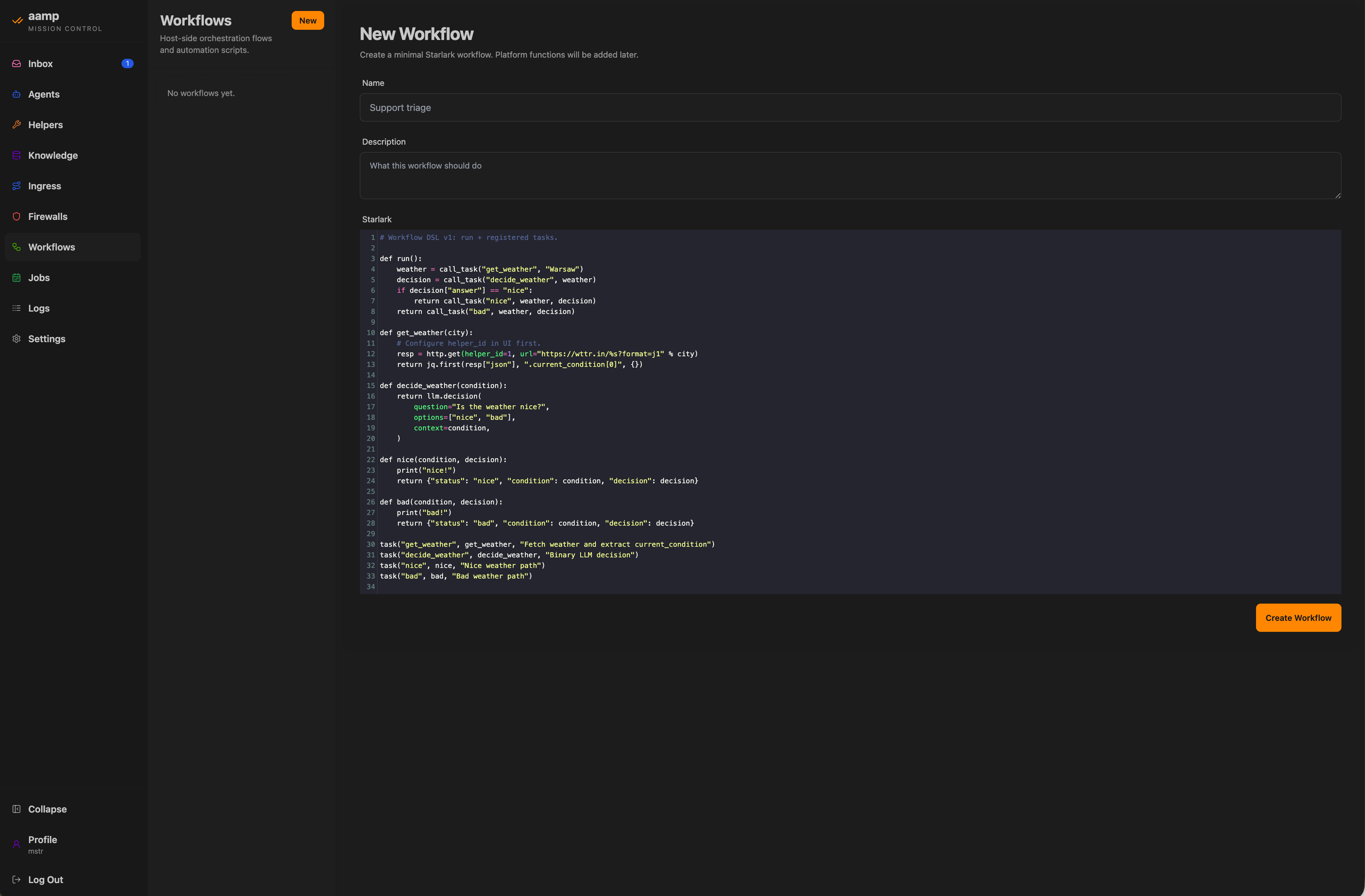
workflows · editor
The aamp workflow editor with a Starlark program
WorkflowsDeterministic Starlark orchestration, with the model invoked as one bounded step.
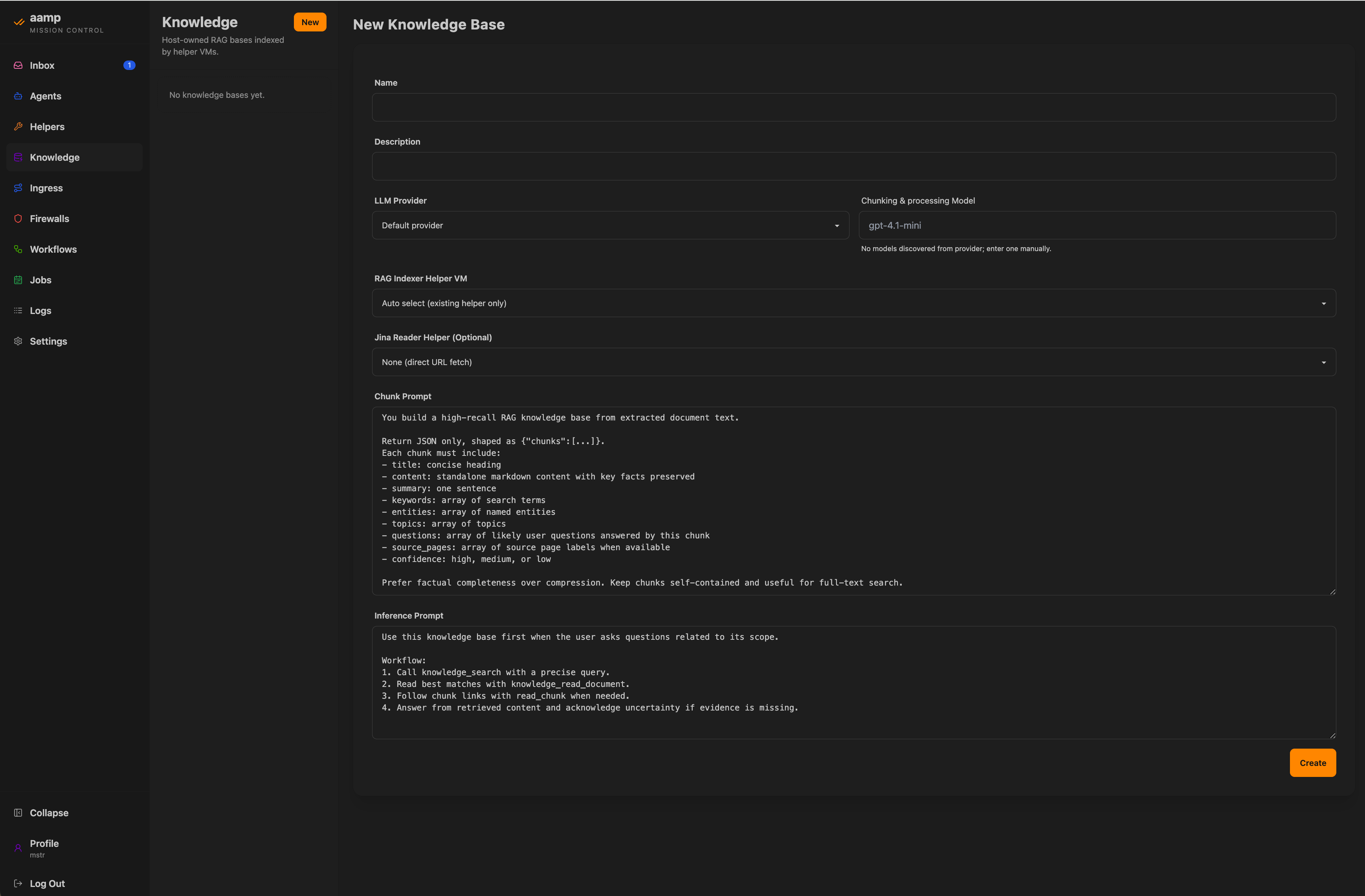
knowledge · new base
Creating a knowledge base in aamp with chunk and inference prompts
KnowledgePer-corpus provider, chunk prompt and inference prompt — retrieval runs host-side.
04 · Observability

Fourteen log domains, queryable per resource.

  • Agent turn and session logs
  • Ingress transport logs
  • Helper execution logs
  • Knowledge indexing and usage logs
  • Capability audit logs
  • Firewall audit logs
  • Workflow run and step logs
  • Proxy and network logs
  • Token spend logs
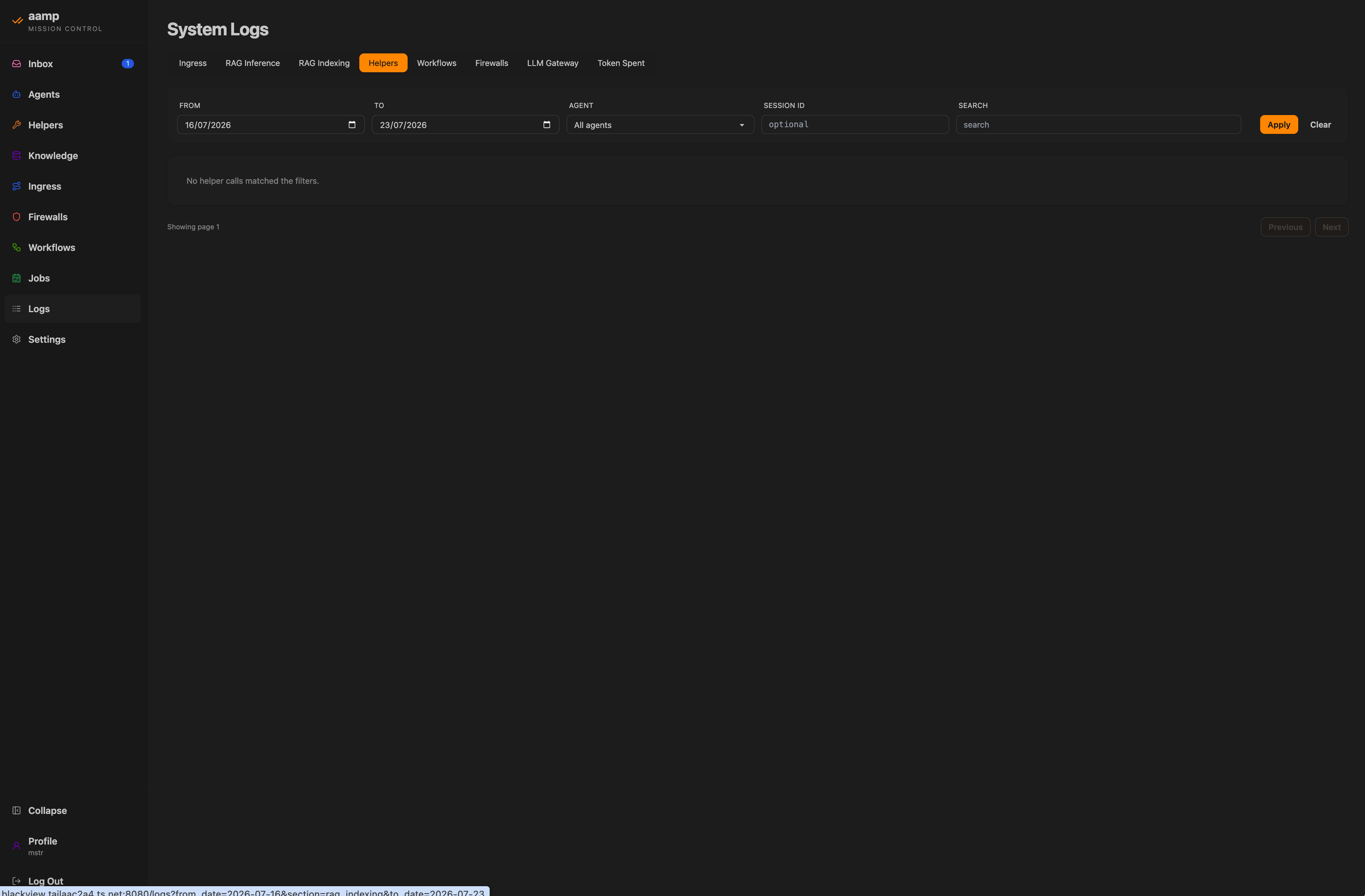
observability · system logs
System logs in aamp with per-domain tabs, filters and token spend
LogsQuery any domain — ingress, RAG, helpers, workflows, firewalls, the LLM gateway and token spend — filtered by date, agent and session.
05 · Deployment

Linux host with KVM. One binary, one database.

A single Go binary, a SQLite database, and local file state. Start on one node. Scale operational rigour without adopting a distributed control plane first.

Requires
  • Linux host with KVM (/dev/kvm)
  • Nested virtualization for private-cloud installs
  • A 32-byte secrets master key
Suits
  • Dedicated on-prem servers
  • Private cloud with virtualisation
  • Isolated lab and staging
  • Internal platform environments where residency matters

State requirements plainly and early. A failed install is a lost deal; an honest prerequisite list is not.

Read the architecture.