Use cases RAG assistant
RAG with 100% local data sovereigntyEnterprise RAG where your data never leaves the perimeter.
Vector indexing and inference hosted entirely on-premise — or on an engineer's workstation.
aamp is not a connector to somebody else's RAG service. It is the full toolset: set up a knowledge base and its indexing pipeline, watch retrieval and indexing as they run, and fine-tune the chunk and inference prompts — all from one console, on your own infrastructure.
- Local embedding
- Local vector store
- Air-gap capable
- Runs on a workstation
A knowledge base you configure, not accept.
Every part of the pipeline is a setting you own — which model chunks the text, what shape a chunk takes, where indexing runs, and how the agent is told to answer.
Provider and chunking model, bound separately.
Set the base LLM provider and, separately, the chunking and processing model that breaks raw text into structured units — a small model like gpt-4.1-mini is usually the right tool for that job. Neither has to be your default agent model.
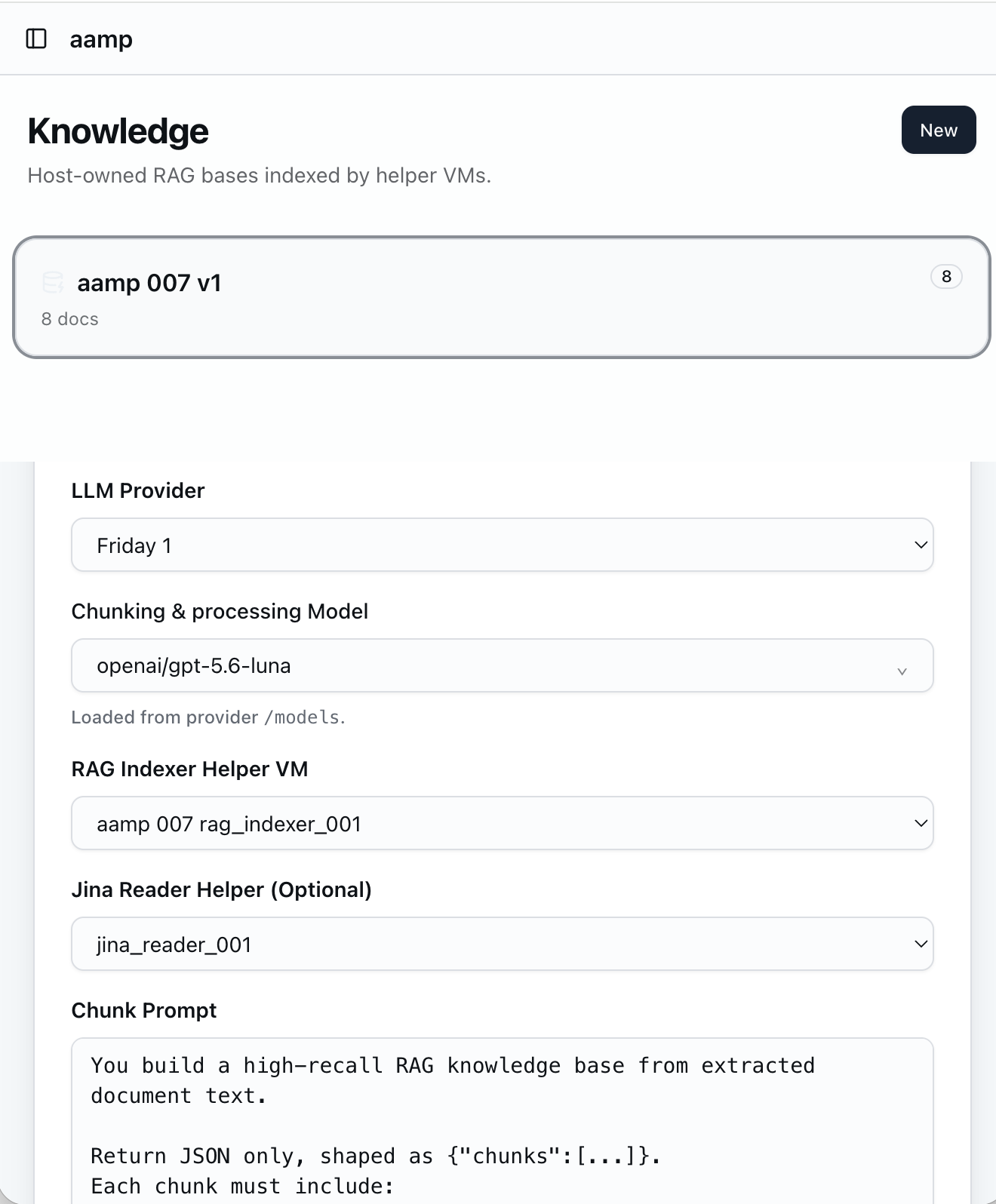
Indexing runs off your main systems.
A RAG Indexer helper VM handles document indexing in an isolated, one-shot environment. The VLM variant adds Docling and GraniteDocling for scanned or image-based documents. An optional Jina Reader helper fetches URL content and scrapes the web when a source lives outside your files.
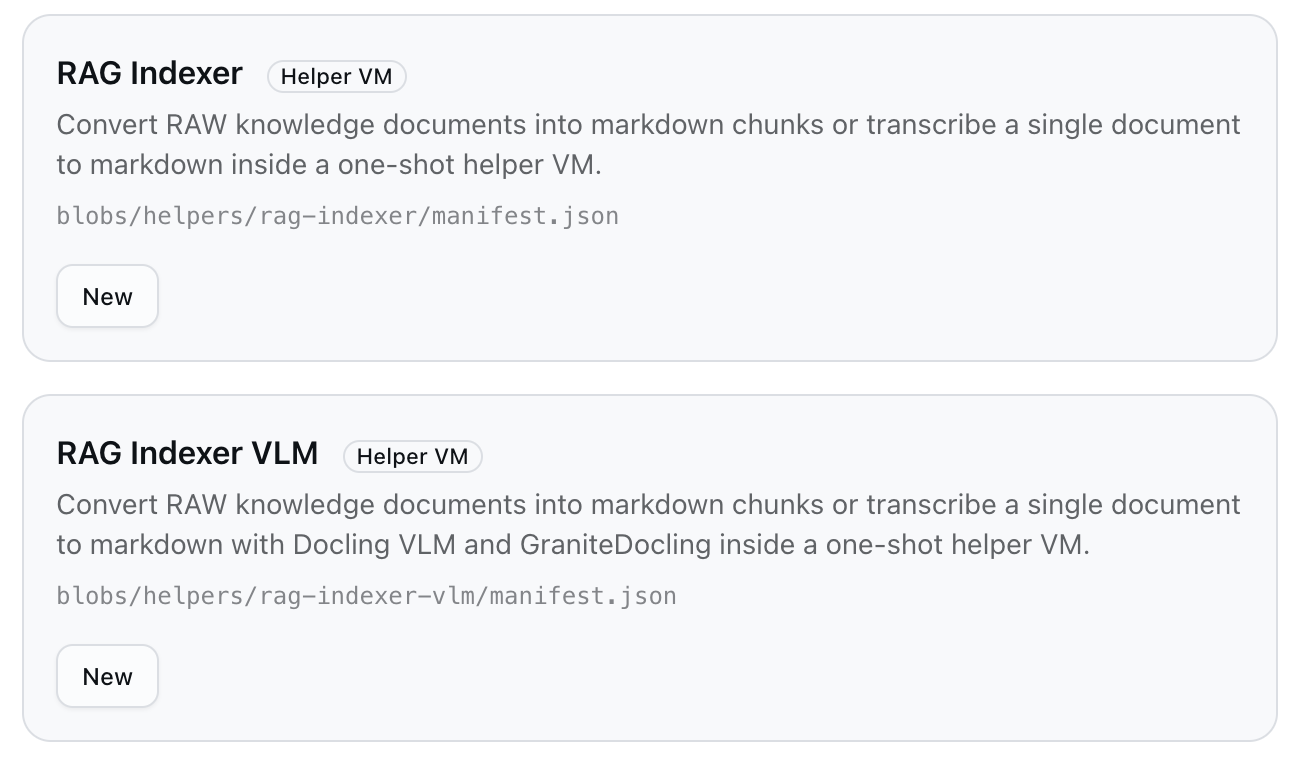
Every base is named and documented.
Each base carries a name and description, so repositories are classified and documented rather than accumulating as unlabelled indexes nobody remembers the purpose of.
Chunks come back as structured JSON.
The extraction pipeline emits standardised JSON. Every chunk carries a title, standalone Markdown content and a summary; contextual tags for keywords, entities, topics and questions; and provenance as source pages plus a confidence level.
Querying is a defined workflow, not a guess.
Call knowledge_search with a precise query, read top matches via knowledge_read_document, traverse relationships with read_chunk, then synthesise from retrieved facts — and state plainly when the evidence is not there.
Indexes are host-owned.
Indexes are stored in host-managed environments, so no third-party model provider retains your proprietary documents or trains on them.
Four steps, one perimeter.
Define the base
Name and describe the repository, then bind the LLM provider and the chunking model that will process it.
Index on isolated compute
The RAG Indexer helper VM parses and indexes documents away from your main systems. Add the Jina Reader helper when a source is a URL rather than a file.
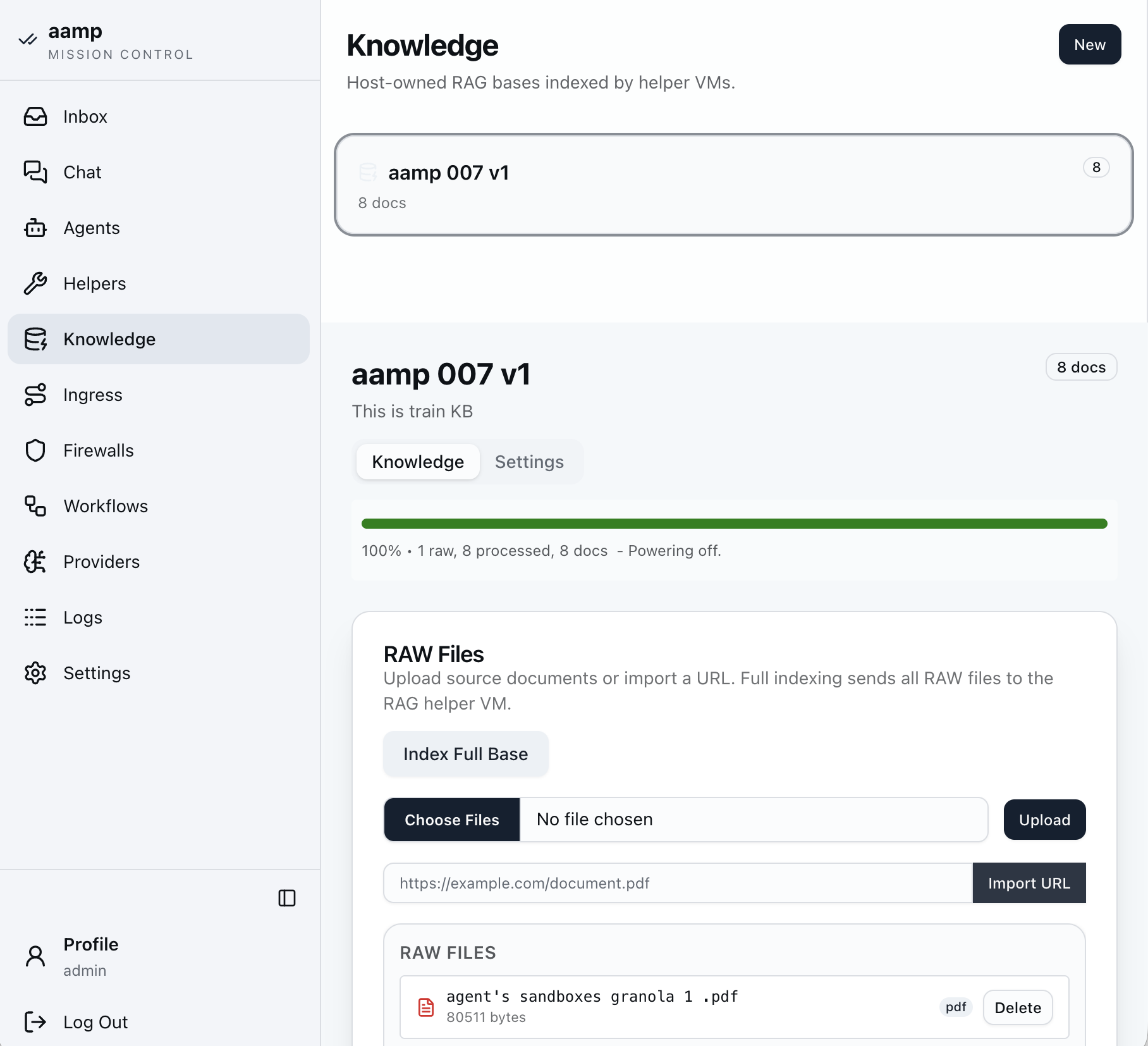
Upload, then index the full base
Raw files sit unindexed until you run indexing. A progress bar tracks raw, processed and doc counts until the helper powers off.
Query with grounded answers
The agent searches, reads the top documents, traverses related chunks, and answers from retrieved facts — citing pages, or saying the evidence is absent.
Sovereignty is structural here.
Four properties of the design, not four settings you have to remember to switch on.
Processing never touches shared memory.
Processing and indexing run on dedicated, isolated virtual machines, keeping raw documents and indexing tasks away from external network vectors and shared memory spaces.
Every answer is checkable against a source.
Strict JSON output and page-level source tracking give full traceability. Every answer is verifiable against an internal source document, which is what prevents a confident invention.
No third party retains your documents.
Indexes live in host-managed environments, so third-party providers cannot retain proprietary enterprise data or train on it.
Missing evidence is stated, not filled in.
Instructing the model to state missing evidence enforces a zero-trust boundary: no unauthorised assumptions, and no leakage across domain scopes.
Sectors where the perimeter is the requirement.
Legal and compliance
Index contracts, regulatory statutes and case law with page-level citation tracing for due diligence and brief preparation.
Healthcare and life sciences
Parse clinical guidelines, medical research and patient care protocols while data stays strictly inside sovereign virtual machines.
Financial services and banking
Query internal audit logs, risk assessments and complex prospectuses without exposing proprietary data to public LLM training pipelines.
Enterprise IT and software engineering
Turn internal codebases, architecture decision records and system logs into structured context for operational support and troubleshooting.
Manufacturing and defence
Index sensitive technical manuals, maintenance schematics and supply chain records on self-hosted or isolated infrastructure to meet sovereignty mandates.