Use cases RAG assistant
RAG with 100% local data sovereigntyEnterprise RAG where your data never leaves the perimeter.
Vector indexing and inference hosted entirely on-premise — or on an engineer's workstation.
aamp is not a connector to somebody else's RAG service. It is the full toolset: set up a knowledge base and its indexing pipeline, watch retrieval and indexing as they run, and fine-tune the chunk and inference prompts — all from one console, on your own infrastructure.
- Documents never leave your company
- Answers with a link to the source
- Works with no internet access
- No token or per-step fees
Answers for your people right away, without reading hundreds of pages.
Manuals, guidelines, policies and contracts become an assistant that answers a question in seconds and shows which document the answer came from. You run the system directly on a company server or a workstation — no files sent to an external cloud, no charges per decision step, and full source verification.
Fewer repeat questions for your experts
The assistant handles the routine questions, so support staff and consultants spend their time on the cases that genuinely need a person.
Support at every stage of a project
The assistant helps with planning and requirement checks (state aid rules, eligibility criteria) as well as day-to-day procedural questions during delivery.
Answers that point back to the source
The assistant draws only on your organisation’s documents and names the chapter, page and clause, so every answer can be checked at the source.
Available outside working hours
Employees, beneficiaries and clients get help in the evening and at the weekend, without adding headcount.
What changes in practice
Finding information drops from half an hour of paging through PDFs to a short conversation. Confidential guidelines and documents stay on your own infrastructure and are never used to train public AI models (GDPR, EU AI Act).
A complete toolkit to launch and run RAG inside your company.
aamp is not a connector to someone else's RAG service. It is the full toolkit: you configure the knowledge base and how it is indexed, watch search and indexing as they run, and tune the chunking and inference prompts — all from one console, on your own infrastructure.
100% on-premise, air-gap ready
The system runs as a single Go binary with an embedded database. You can start it directly on a workstation or a local server with no internet access.
Precise citations and verifiable sources
Every answer is grounded in the context provided and carries references to the specific source documents (PDF, DOCX, databases), so it can be checked at the source.
0% token margin, no per-step fees
You pay for the orchestration engine, not for the number of vector-store queries or decision loops. Connect any local engine (Ollama, vLLM) or bring your own API key.
Full isolation, GDPR and EU AI Act compliance
Commercial documents, contracts, medical and financial data never leave your infrastructure. Operations are protected by hardware-level Firecracker microVM isolation and dual safety firewalls.
Turn an outdated knowledge base into a secure AI assistant: a four-step conversion
Define the base
Name and describe the repository, then bind the LLM provider and the chunking model that will process it.
Index on isolated compute
The RAG Indexer helper VM parses and indexes documents away from your main systems. Add the Jina Reader helper when a source is a URL rather than a file.
Upload, then index the full base
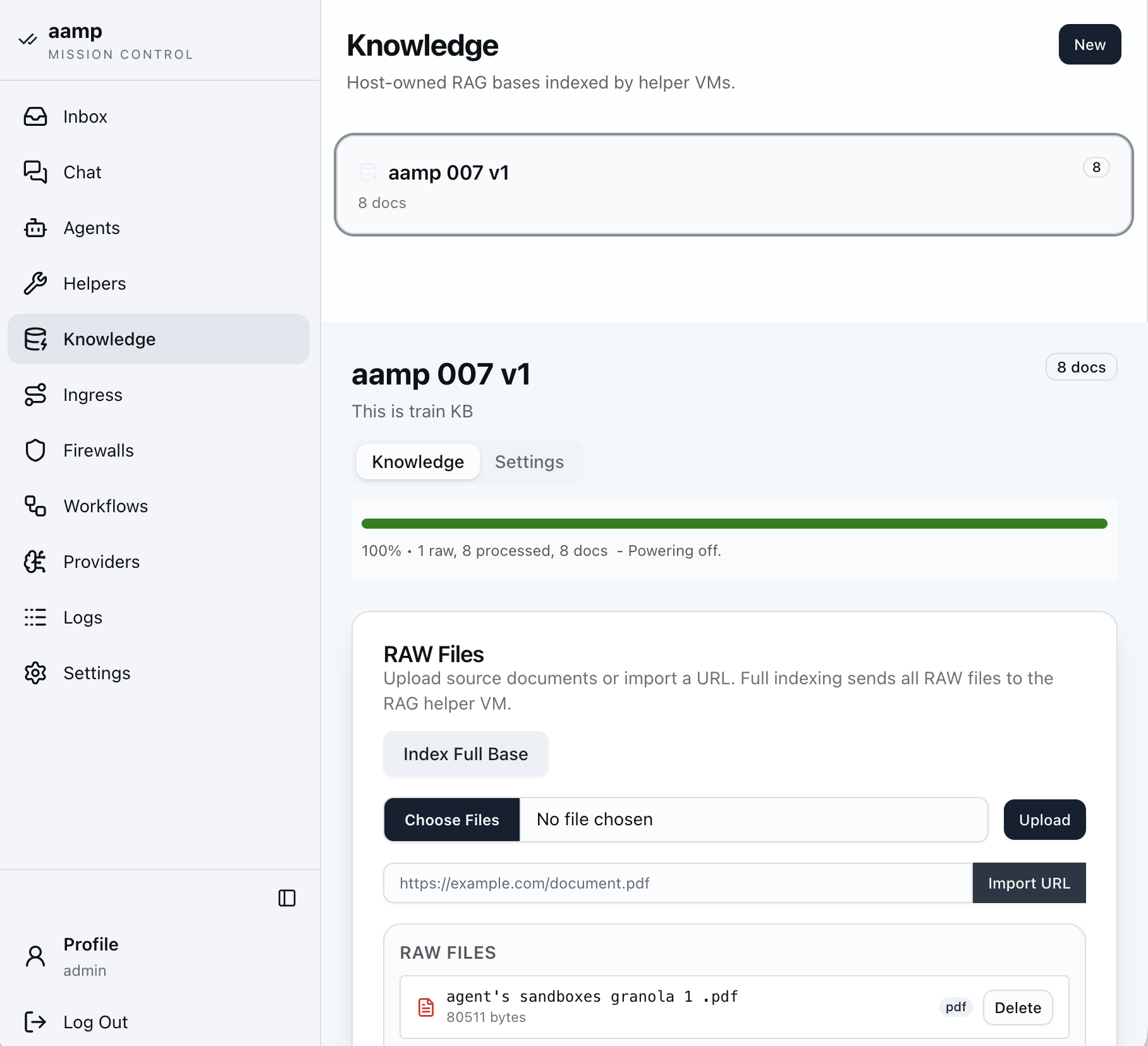
Raw files sit unindexed until you run indexing. A progress bar tracks raw, processed and doc counts until the helper powers off.
Query with grounded answers
The agent searches, reads the top documents, traverses related chunks, and answers from retrieved facts — citing pages, or saying the evidence is absent.
Sovereignty is structural here.
Four properties of the design, not four settings you have to remember to switch on.
Every answer is checkable against a source.
Strict JSON output and page-level source tracking give full traceability. Every answer is verifiable against an internal source document, which is what prevents a confident invention.
No third party retains your documents.
Indexes live in host-managed environments, so third-party providers cannot retain proprietary enterprise data or train on it.
Missing evidence is stated, not filled in.
Instructing the model to state missing evidence enforces a zero-trust boundary: no unauthorised assumptions, and no leakage across domain scopes.
Processing never touches shared memory.
Processing and indexing run on dedicated, isolated virtual machines, keeping raw documents and indexing tasks away from external network vectors and shared memory spaces.
Sectors where the perimeter is the requirement.
Index contracts, regulatory statutes and case law with page-level citation tracing for due diligence and brief preparation.
Parse clinical guidelines, medical research and patient care protocols while data stays strictly inside sovereign virtual machines.
Query internal audit logs, risk assessments and complex prospectuses without exposing proprietary data to public LLM training pipelines.
Turn internal codebases, architecture decision records and system logs into structured context for operational support and troubleshooting.
Index sensitive technical manuals, maintenance schematics and supply chain records on self-hosted or isolated infrastructure to meet sovereignty mandates.